A request to share your location can be presented as concern. Monitoring read receipts may be dismissed as reassurance. Demanding access to passwords can be framed as a sign of trust. But when does apparent care become control?
This is the question at the heart of new global thought leadership commissioned as part of YSL Beauty’s Abuse Is Not Love programme.
Authored by leading psychologist Dr. Nina Jane Patel, Abuse Is Not Love: Failure to Recognise Technology Facilitated Intimate Partner Violence examines why young people can struggle to identify digitally abusive behaviour within their own relationships.

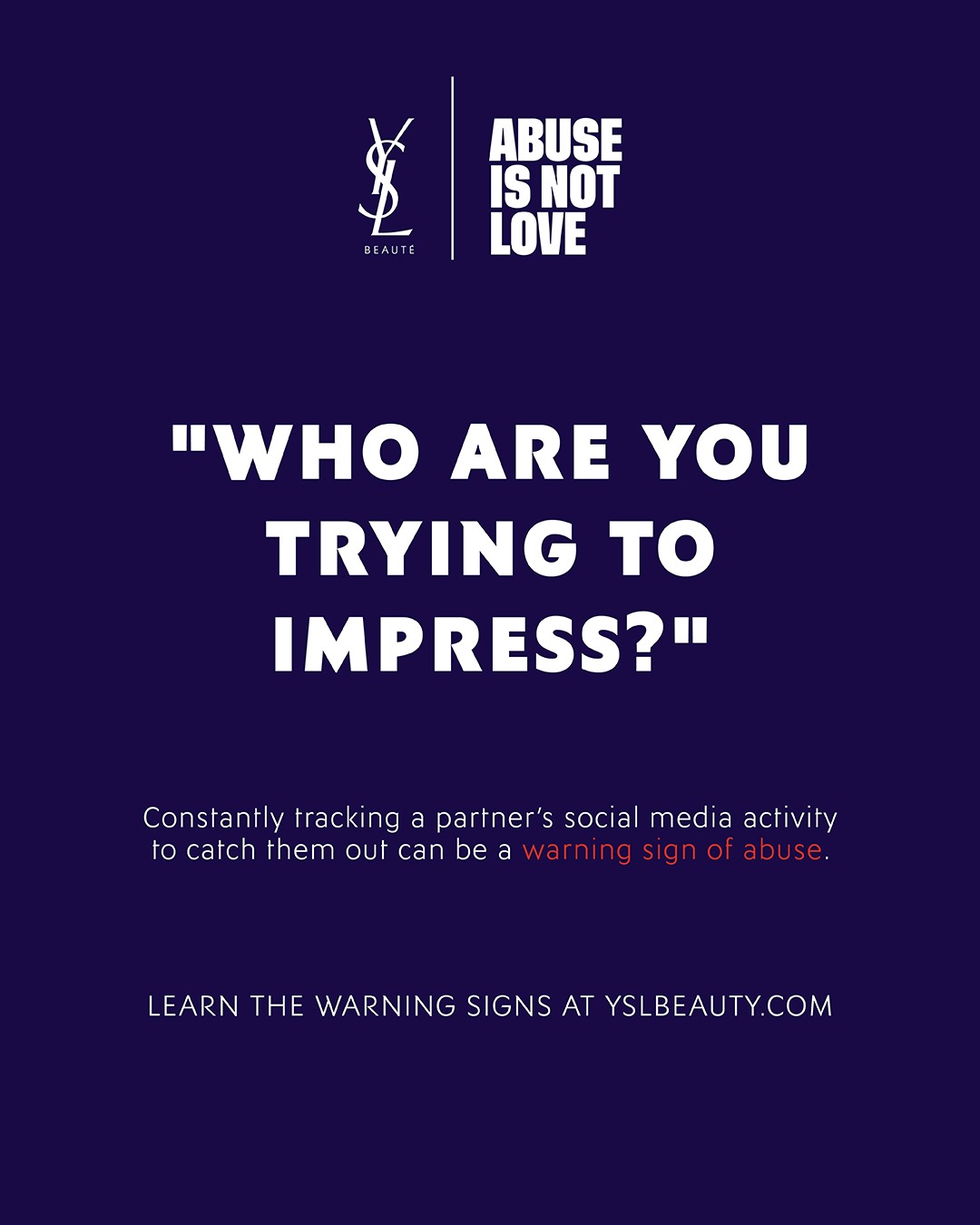
Technology-facilitated intimate partner violence, known as TFIPV, can include constant location tracking, demands for passwords, excessive check-ins, monitoring online activity and using digital communication to intimidate, isolate or control a partner.
According to the report, this form of abuse has surged globally by 62% in recent years. However, many of the young people experiencing it may not recognise the behaviour as abusive.

How Digital Control Hides in Plain Sight
Digital monitoring has become embedded in everyday life. Families use location-sharing applications for safety, friends monitor one another’s activity and couples can see when messages have been read or when someone was last online.
While these tools are not inherently harmful, the report suggests that their widespread use has made it increasingly difficult for young people to distinguish between consensual connection and coercive surveillance.
Intrusive behaviour may consequently be interpreted as care, isolation mistaken for love and control reframed as protection.
This is something I have experienced personally. It does not always begin with behaviour that immediately feels threatening or abusive. It can happen very slowly. Because so much of our lives now takes place digitally, it can be frighteningly easy to be manipulated into gradually accepting surveillance as a normal part of a relationship.
A request for your location can initially appear protective. Questions about who you are messaging may be disguised as interest, while the expectation of an immediate reply can be framed as affection. Each demand can seem small in isolation, but over time, those behaviours can quietly erode your privacy, independence and sense of what is acceptable.
It is often only when you step back that you recognise how closely you were being watched.
Drawing upon qualitative analysis with NGO experts across France, Spain, the US, the UK, Sweden, South Africa, Indonesia, Greece, Brazil and the Czech Republic, the research identifies young people aged between 16 and 24 as particularly vulnerable—and among those least equipped to describe what is happening to them.
Unlike physical violence, digital abuse may leave no visible signs. Instead, it can create a persistent sense of being watched: pressure to respond immediately, fear of missing a call or anxiety about what a partner might conclude from an online interaction.
Without the language to identify these patterns, controlling behaviour can be dismissed as jealousy, intensity or simply part of being in a modern relationship.

When sharing stops being a choice
Context and consent are critical. Choosing to share a location is very different from being pressured to do so. Offering a password voluntarily is not the same as being told that refusal proves there is something to hide.
The report also explores how well-intentioned parental tracking may inadvertently teach young people that love requires continuous access and that privacy is incompatible with trust. These expectations can then be carried into romantic relationships, where surveillance is presented as proof of devotion.
Even when victims seek help, the response may fail to acknowledge the seriousness of the abuse. Being advised to block a partner or stop using a particular platform places the responsibility on the person experiencing the behaviour, without addressing the coercion behind it.
AI presents a new threat
The report identifies generative artificial intelligence as an emerging multiplier of harm.
AI tools can be used to produce deepfake imagery for humiliation or extortion, create deceptive messages and reinforce toxic relationship behaviours. As technology develops faster than education, legislation and safeguarding systems can respond, young people may be left navigating increasingly sophisticated forms of abuse without adequate protection.
This makes education about healthy digital boundaries more urgent than ever.
Why this message matters from a beauty brand
I find it particularly powerful that this message is coming from YSL Beauty.
We may expect to encounter conversations about intimate partner violence through charities, campaign groups or specialist organisations. These voices are vital, but they may not always reach someone who does not yet recognise that they are experiencing abuse.
A beauty brand can introduce the message in a completely different and almost unavoidable way. YSL Beauty may already be in someone’s makeup bag, on their dressing table or appearing naturally within the content they consume every day.
It allows an urgent conversation to reach people in a familiar space – perhaps before they would ever think to search for information about coercive control or digital abuse themselves. If someone recognises even one aspect of their own relationship within this campaign, that moment of recognition could be incredibly important.

Abuse Is Not Love
The expert commentary forms part of YSL Beauty’s Abuse Is Not Love programme, a global initiative dedicated to preventing and addressing intimate partner violence.
The programme focuses on prevention, identification and access to support, with particular attention given to young people aged 16 to 24. It is currently active across 30 markets worldwide.
One in three women will experience sexual, physical, psychological or financial violence from a partner during her lifetime. Through its continued work to raise awareness of emerging forms of abuse, YSL Beauty aims to help people recognise warning signs that may otherwise remain hidden.
Dr. Nina Jane Patel works at the intersection of embodied psychology, child development and emerging technology. A movement psychotherapist, author and mother of four, she has advised families, schools, charities, technology companies and policymakers on the ways children and young people experience digital environments.
Her latest work delivers a crucial message: constant access is not the same as intimacy, surveillance is not reassurance and control should never be mistaken for care.
As relationships become increasingly connected through technology, recognising that difference could not be more important.