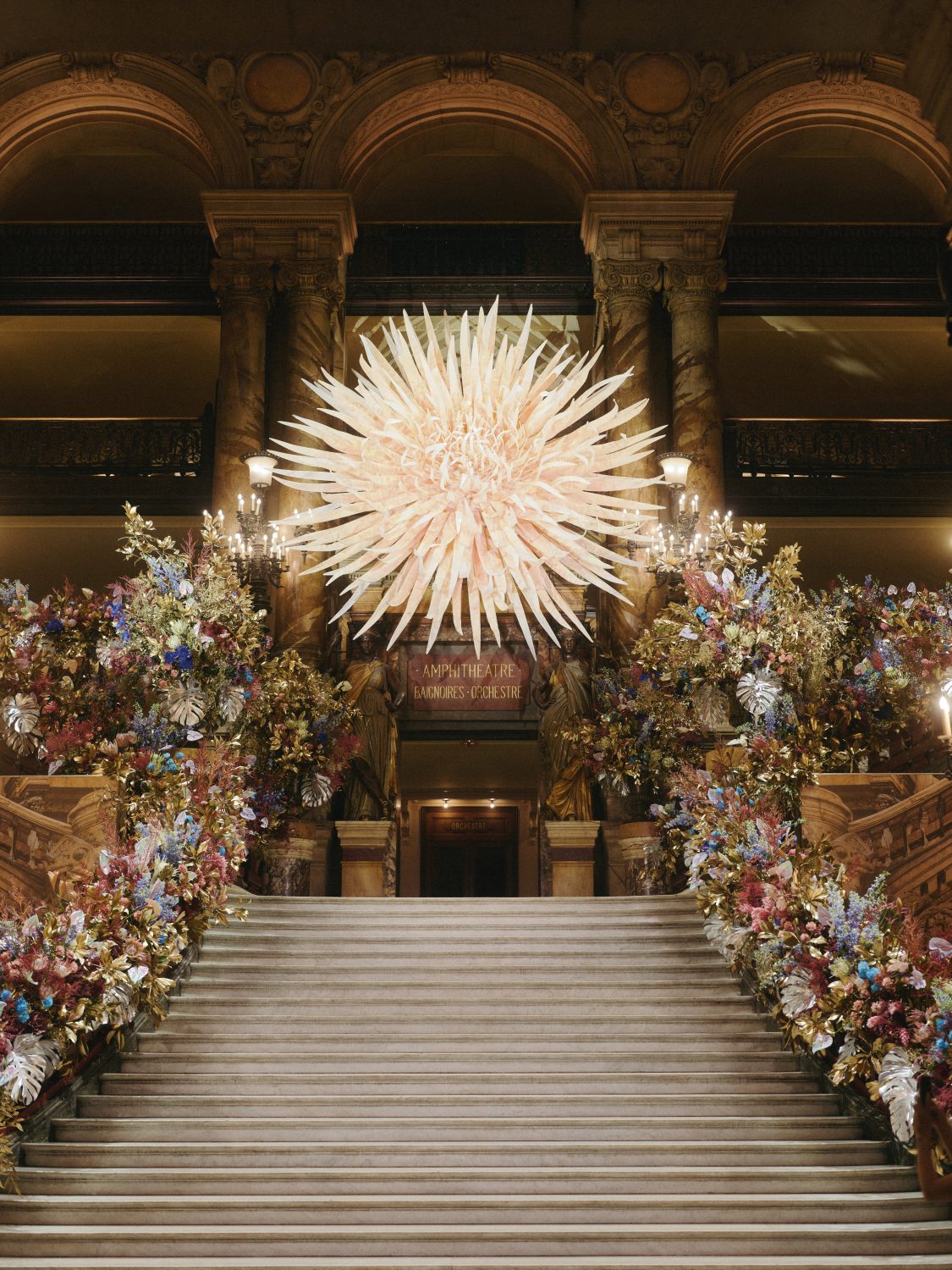
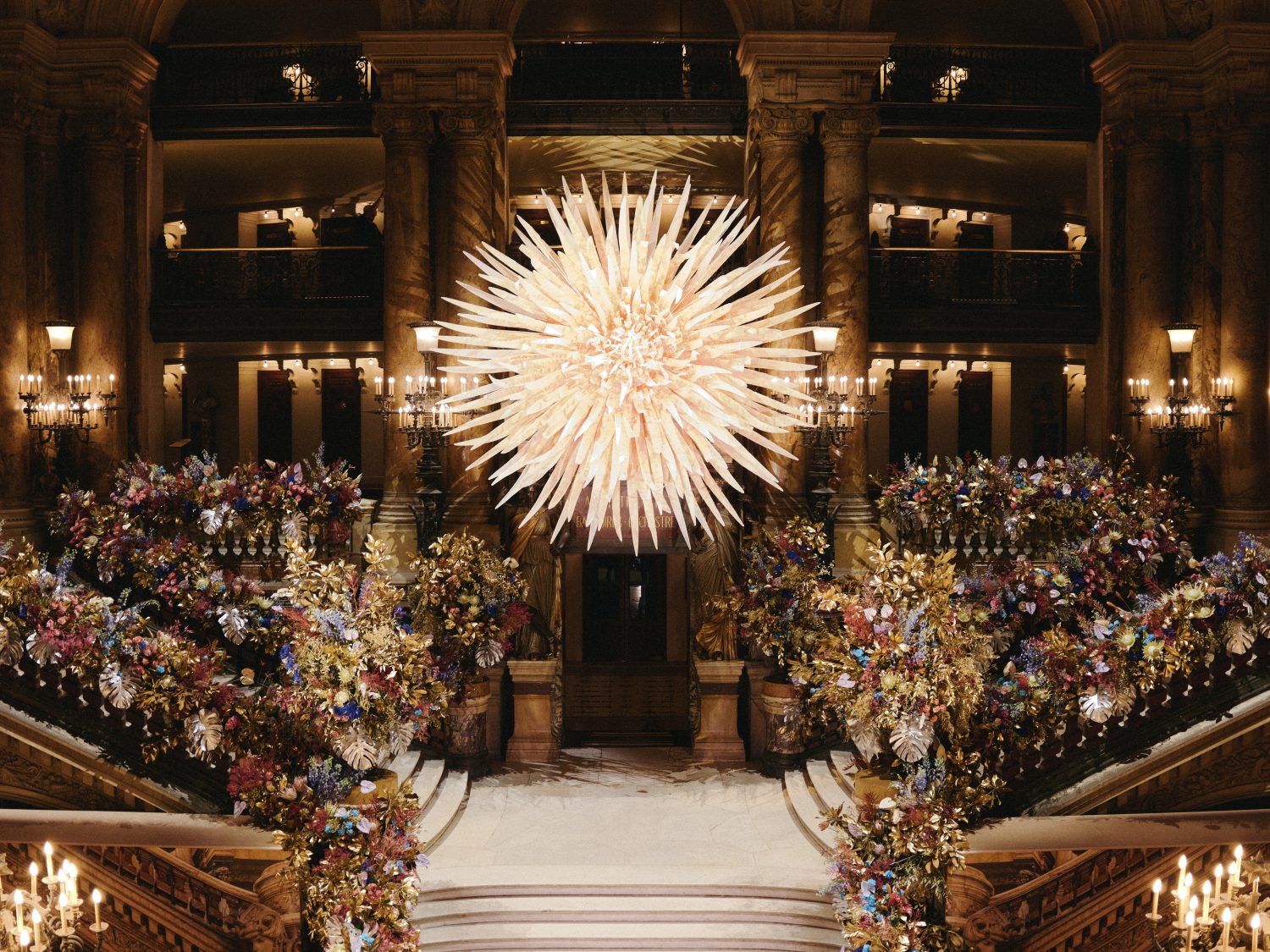
There are evenings in Paris that feel like scenes from a dream. Beneath the gilded balconies, carved stone and theatrical grandeur of the Paris Opera, light spilled across marble while flowers seemed to climb the great staircase in clouds of gold, crimson, violet and blue. At its heart, an extraordinary illuminated sculpture bloomed like a celestial sun: part star, part flower, part piece of stage magic. It was an appropriately fantastical setting for an evening devoted to one of the purest forms of artistic expression – dance.
For the Opening Gala of the Paris Opera’s 2026/27 dance season, CHANEL once again stood alongside the institution it has supported for years, continuing a relationship between fashion and ballet that stretches back more than a century.
Patron of the Paris Opera’s dance season Opening Gala since 2018, Major Patron of the Paris Opera since 2023 and Exceptional Patron of its renovation since 2025, the House has become woven into the fabric of the occasion.
A Night Devoted to Dance
The Opening Gala is one of the defining moments of the Paris Opera Ballet calendar, bringing together every generation of its dancers. Students from the École de Danse share the evening with the company’s Étoiles, while the Junior Ballet – created in 2024 and supported by CHANEL as Founding Patron – takes its place within this extraordinary continuum of talent.
It is difficult to imagine a more beautiful expression of succession. Young dancers at the very beginning of their careers appear within the same world as artists who have already reached ballet’s highest ranks; technique, knowledge and tradition pass almost invisibly from one generation to the next.
This season’s programme brings that heritage into conversation with the new. Rings of Saturn marks choreographer Juliano Nuñes’ first creation for the Paris Opera, with costumes created by CHANEL. The programme also introduces Jean-Christophe Maillot’s Vers un pays sage and Aszure Barton’s Busk to the Paris Opera repertoire.
CHANEL Dresses the Ballet
For the Junior Ballet’s second appearance at the Opening Gala, its dancers wore tutus designed by CHANEL.
There is something wonderfully poetic about the meeting of the two crafts. A couture atelier and a ballet company are both worlds obsessed with the smallest detail. A millimetre matters. A line matters. Movement matters. What appears effortless from the outside is achieved through extraordinary discipline behind the scenes.
The Junior Ballet itself comprises dancers aged between 18 and 25, selected through auditions for a two-year professional training contract. At its heart are ideas of transmission, inclusion and opening the arts to wider audiences – principles shared by both the Paris Opera and CHANEL.
For the celebrated Défilé du Ballet, CHANEL also created tutus and tiaras for the Étoiles.
Against the immense scale of the stage, the effect is almost otherworldly. Rows upon rows of dancers dressed in white create a living tableau: satin, tulle and bodies arranged with architectural precision beneath the glow of the theatre. The orchestra sits below; the dancers appear to rise endlessly beyond it.
For a moment, Paris becomes a fairytale but the beauty is deeper than just decorative. Behind every extended arm, every perfectly placed foot and every shimmering costume are years of work. That tension and enchantment, supported by rigorous technique is perhaps where ballet and CHANEL understand one another best.
A Love Affair Between Fashion and Dance
The relationship between CHANEL and dance began with Gabrielle Chanel herself. In 1920, she met Sergei Diaghilev, the visionary founder of the Ballets Russes. Four years later, she designed costumes for Le Train Bleu, bringing the radical modernity of her fashion into the world of ballet.
Further collaborations followed. In 1928 came costumes for George Balanchine’s Apollon Musagète; in 1939, Léonide Massine’s Bacchanale.
The connection was never simply about dressing dancers beautifully. Chanel recognised ballet as a world of experimentation – one in which music, movement, costume and design could collide to create something entirely new.
Nearly a century later, that dialogue continues. In 2019, CHANEL revisited the costumes for Serge Lifar’s Variations. The House created costumes for Sidi Larbi Cherkaoui’s Exposure in 2020 and Victor Gsovsky’s Grand Pas Classique in 2021.
In 2025, it designed thirteen stage costumes for Red Carpet, Hofesh Shechter’s first creation for the Paris Opera Ballet. Étoiles including Amandine Albisson, Valentine Colasante and Hannah O’Neill have also worn CHANEL-designed stage costumes during previous Opening Galas. Each project becomes another stitch in a relationship that now spans generations.
Where Couture Meets Choreography
There is an inherent romance in the idea of CHANEL at the Paris Opera, but perhaps the most compelling thing about the partnership is how naturally the two worlds fit together.
Both begin with the body. A choreographer considers the way it moves through space. A designer considers how fabric will respond to that movement. Ballet relies on line, proportion, rhythm and discipline; so does extraordinary fashion.
When the two meet on stage, clothes cease to be static objects. A skirt catches the air. Tulle becomes almost weightless. Embellishment flashes beneath a spotlight for a fraction of a second before disappearing again. What was constructed quietly in an atelier becomes part of a gesture, a leap, a turn. Fashion is transformed by movement and movement is transformed by fashion.
An Evening Suspended in Time
That is the magic of the Paris Opera’s Opening Gala, for a few hours, generations of dancers exist together beneath one roof. Students stand where Étoiles once stood as children. New choreography enters a repertoire built over centuries. A fashion house founded in another era continues a creative conversation begun by Gabrielle Chanel herself.
Beneath chandeliers and gilded balconies, another world exists entirely. An orchestra begins to play. The curtain rises. Hundreds of dancers take their places. White tutus float against the darkness and tiaras catch the light and for one perfect evening, the Paris Opera reminds us what a great privilege it is to watch such exquisite art become alive.