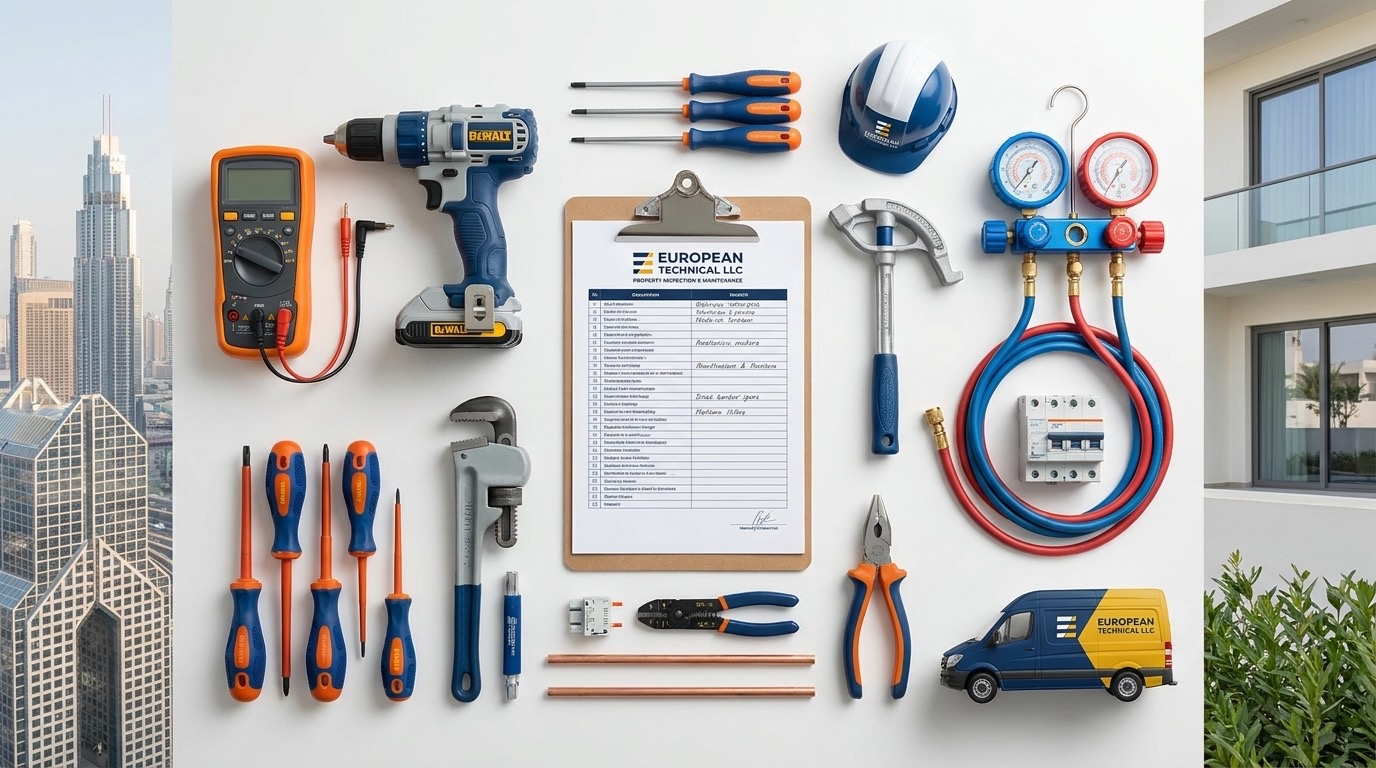
An annual maintenance contract, usually shortened to AMC, is a fixed-term agreement between a property owner and a maintenance provider. The owner pays a set fee for a defined year of work. The provider commits to a schedule of inspections, a list of included repairs, and a response time when something fails.
The concept is old and unglamorous. It’s also widely misunderstood, mostly because the term gets applied to agreements that differ enormously in scope. Two contracts can both be called an AMC and cover almost nothing in common.
This piece sets out what these contracts typically include, where the boundaries usually sit, and which clauses determine whether one is worth the money.
The Four Standard Trades
Residential AMCs are generally built around the same four disciplines.
Air conditioning is the anchor service in hot climates and usually the reason people sign in the first place. A contract will specify a number of servicing visits per year and a unit cap. Servicing means filter cleaning, coil cleaning, condensate drain clearing, gas pressure checks, thermostat calibration, and an electrical check on the outdoor unit.
Plumbing coverage centres on inspection of visible pipework, water heaters, valves, traps, and fixtures, plus a check of mains pressure. Leak detection is included in most contracts. Repair of leaks may or may not be, which is the important distinction.
Electrical work covers distribution board inspection, earthing verification, socket and switch testing, load checks, and inspection of light fittings and their drivers.
Handyman scope is the loosest category and varies most between providers. It typically means carpentry adjustments, door and lock alignment, fixing loose fittings, silicone renewal, minor tiling repairs, and mounting work.
Inspection Versus Repair
This is the single most consequential line in any AMC and the one that generates the most disputes.
Entry-level contracts are frequently inspection-only. The provider attends, examines the systems, and reports what needs doing. Any actual repair is quoted separately, usually at a discount to standard rates. The value is early detection and cheaper labour, not free fixes.
Mid and upper tiers include what’s normally described as minor repairs. That phrase needs pinning down. Ask for a parts cost ceiling, a labour hours limit, or an explicit list. A provider who won’t define minor is telling you something.
Almost no residential AMC includes major component replacement. A failed AC compressor, a new water heater, a rewired circuit, or a burst embedded pipe requiring floor removal will be chargeable. That’s a reasonable exclusion, since insuring against those events is a different financial product entirely.
Response Time and Emergency Cover
Contracts differentiate heavily on response.
Standard tiers commonly promise attendance within four to eight working hours on weekdays. Premium tiers compress that and extend it to nights and weekends. As an illustration of the range, European Technical’s [AMC packages](https://europeantechnical.ae/amc) in Dubai run a four-hour standard response on the entry plan, two hours on the mid tier, and one hour on the top tier, with unlimited emergency callouts above the entry level.
Two follow-up questions matter more than the headline number. First, is the clock measured from the call or from the start of the next working day? Second, does the response guarantee carry any remedy if missed? A guarantee with no consequence attached is a marketing claim.
Pricing Structures
Residential pricing is normally banded by property type and size. Apartments cost less than villas. Bedroom count or unit count drives the tier.
For context, entry-level apartment cover in Dubai currently starts around AED 1,499 per year, roughly AED 125 monthly. Full villa cover with quarterly inspections and included repairs sits nearer AED 4,000 annually. Commercial and portfolio agreements are priced individually against a surveyed asset list. Providers like European Technical also publish [detailed AC maintenance guides](https://europeantechnical.ae/blog/ac-maintenance-tips-dubai-summer) and a [full services directory](https://europeantechnical.ae/services) covering all four trades.
Watch for three cost mechanics. Whether monthly billing carries a premium over annual payment. Whether the discount on out-of-scope work is meaningful, typically 10 to 30 percent. And whether call-out charges apply on top of the fee for anything.
Exclusions to Read Carefully
Most contracts exclude the same categories. Pre-existing faults identified at the initial survey. Damage from misuse, tampering, or third-party work. Consequential loss, meaning the water damage caused by a leak rather than the leak itself. Structural and building-envelope items such as roofing, facades, and windows. Cosmetic decoration. Specialist systems including pools, lifts, generators, and home automation, unless separately scoped.
Pest control and duct cleaning sometimes appear as inclusions on top tiers and sometimes as paid extras. Both are worth confirming rather than assuming.
Documentation
A properly run contract produces a paper trail. You should expect a dated service report per visit, ideally with photographs, listing what was checked, what was found, what was done, and who attended.
For landlords in regulated rental markets this record has direct utility. It evidences that maintenance obligations under a tenancy were met and supports the position in any dispute over deposit deductions or habitability. For owner-occupiers it forms a building history that has real value at resale.
Term, Renewal, and Exit
Twelve months is the standard term. The clauses that vary are the ones worth negotiating.
Look for a cooling-off period, commonly seven to fourteen days with a refund. Check whether early cancellation is possible and on what notice, since some providers allow exit after six months. Confirm whether renewal is automatic and how price increases at renewal are handled. Establish whether the workmanship warranty on completed repairs survives the end of the contract, and for how long. Twelve months is typical.
Who Tends to Benefit
The economics favour some owners more than others.
Older properties with ageing systems generate enough reactive work to make fixed pricing attractive. Owners of multiple units get scale benefits and a single point of contact. Absentee owners and landlords buy administrative relief as much as maintenance. Anyone in a harsh climate, where equipment degrades faster than the design assumption, faces a higher baseline failure rate.
The weakest case is a new-build apartment still inside developer warranty with one or two AC units. There, ad hoc servicing usually costs less than a contract for the first couple of years.
A Short Checklist
Before signing, get written answers on these points. Exact list of included repairs with a value limit. Number of visits and any unit caps. Response time definition and remedy for breach. Full exclusion list. Whether technicians are employed or subcontracted. Discount rate on additional work. Cancellation terms and refund window. Length of workmanship warranty. Format and timing of service reports.
An AMC that answers all nine clearly is straightforward to evaluate. One that doesn’t isn’t worth the paperwork.